Buying Guides
Fireclay vs Vitreous China Kitchen Sinks: What Buyers Should Know
Fine fireclay (FFC) and vitreous china farmhouse sinks compared on strength, size range, weight, finish, installation and price, with a checklist for importers.

Key takeaways
- Fine fireclay (FFC) is fired at high temperature with a thick enamel glaze, making it suitable for large, deep farmhouse and butler sinks.
- Vitreous china is lighter and more cost-efficient for mid-size apron sinks.
- Inspect flatness, glaze defects and dimensional tolerance; specify cabinet base sizes and drain positions before ordering.
Apron-front farmhouse sinks remain one of the strongest categories in kitchen renovation. For importers the first decision is the ceramic body: fine fireclay (FFC) or vitreous china (VC).
The two materials
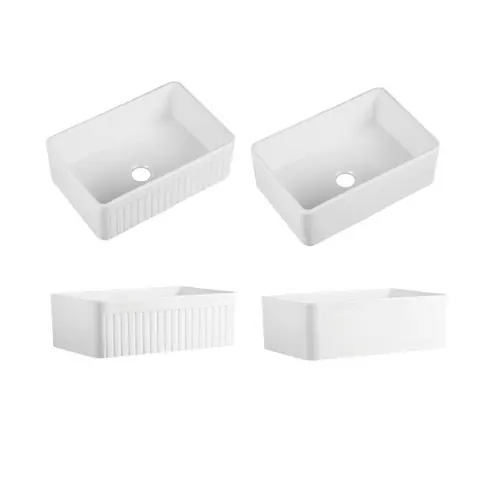
Fine fireclay is a dense clay body fired at very high temperature and finished with a thick enamel glaze. It suits large, deep bowls such as our 33-inch YS27108W-3320 and the double-bowl YS27102W-3318D.
Vitreous china is a finer, lighter ceramic body that is efficient to produce in mid-size formats, such as the reversible YS27111W-3020.
Side-by-side
| Factor | Fine fireclay (FFC) | Vitreous china |
|---|---|---|
| Typical wall thickness | Thicker, around 3–5 mm glaze-and-body | Thinner |
| Size range | Large and deep formats | Small to medium |
| Weight | Heavier — needs a strong base cabinet | Lighter |
| Colours | White, black and custom glazes | Mainly white |
| Cost | Higher | Lower |
Installation considerations
- Apron sinks are usually installed undermount on a reinforced base cabinet; confirm the cabinet width before ordering.
- Reversible models offer a plain face and a decorative face — one SKU covers two looks.
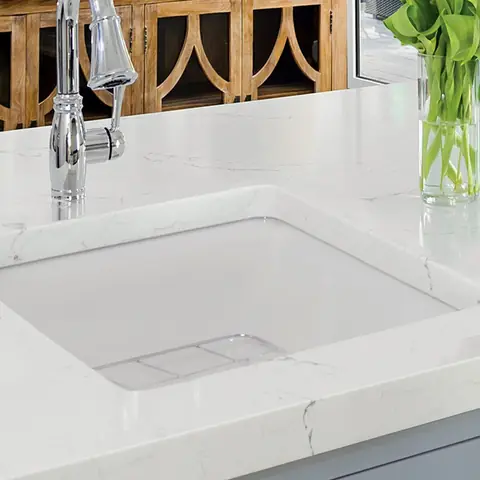
- Grids and basket strainers, as supplied with the YS27106W butler sinks, protect the glaze and add value at retail.
Inspection checklist
- Rim flatness on a reference table — important for undermount sealing.
- Glaze defects: pinholes, crawling and colour variation under daylight.
- Overall dimensions and drain position within agreed tolerance.
- Drop-test and packaging: corner protection and double-wall cartons for heavy FFC sinks.
Frequently asked questions
Do fireclay sinks chip?
The enamel is very hard, but a heavy cast-iron pan dropped on an edge can chip any ceramic. Bottom grids reduce the risk significantly.
Can you produce custom sizes?
Custom sizes require new moulds and minimum quantities. Contact us with drawings and annual volume for an assessment.